Divine Mercy Inspiration
All Things Possible Catholic Mission Society embraces and lives the message of Divine Mercy.
The Diary of Saint Maria Faustina Kowalska is the record of her life experience – the journey of her soul. She was graced by a special communion with God, and the Diary expresses her conviction that this communion ought to be the centre of our lives.
On April 3, 2005 as part of the Regina Caeli Message prepared by Pope John Paul II, he said: “How much the world needs to understand and accept Divine Mercy! Lord, who reveal the Father’s love by Your death and Resurrection, we believe in You and confidently repeat to You today: Jesus, I trust in You, have mercy upon us and upon the whole world.”
THREE O’CLOCK IN THE AFTERNOON – THE HOUR OF GREAT MERCY
As one reads the Diary of Saint Maria Faustina Kowalska, one comes upon the following prayer:
You expired, Jesus, but the source of life gushed forth for souls and the ocean of mercy opened up for the whole world. O Fount of Life, unfathomable Divine Mercy, envelop the whole world and empty Yourself out upon Us (Diary, 1319).
Immediately after these words, and without any further explanation, St. Faustina records this unexpected request of our Lord:
At three o’clock, implore My Mercy, especially for sinners; and, if only for a brief moment, immerse yourself in My Passion, particularly in My abandonment at the moment of agony. This is the hour of great mercy for the whole world…In this hour, I will refuse nothing to the soul that makes a request of Me in virtue of My Passion (Diary, 1320).
About four months later, again, without any introduction, St. Faustina penned these words of our Lord:
I remind you, My daughter, that as often as you hear the clock strike the third hour, immerse yourself completely in My mercy, adoring and glorifying it; invoke its omnipotence for the whole world, and particularly for poor sinners; for at that moment mercy was opened wide for every soul. In this hour you can obtain everything for yourself and for others for the asking; it was the hour of grace for the whole world – mercy triumphed over justice.
My daughter, try your best to make the Stations of the Cross in this hour, provided that your duties permit it; and if you are not able to make the Stations of the Cross, then at least step into the chapel for a moment and adore, in the Blessed Sacrament, My Heart, which is full of mercy; and should you be unable to step into the chapel, immerse yourself in prayer there where you happen to be, if only for a very brief instant. I claim veneration for My mercy from every creature…(Diary, 1572).
We remember, then, the hour in which the saving death of Jesus was accomplished. We remember the hour when all was “finished” and with His last breath, Jesus bequeathed His Holy Spirit “for the life of the world.” Our thoughts also run to the hour as the moment when Christ’s side was pierced, from which there flowed immediately “a fount of mercy for us,” and of the hour in which the kingdom of God was opened for all as for the repentant thief. Jesus appears to desire very much such a remembrance at the Hour of Great Mercy. In fact, in view of the sweeping promise He attached to it, He appears also to prize it very highly.
We would do well in this same hour to say another little prayer, taught to St. Faustina by our Lord, which she repeated every morning and often during the day to renew her act of consecration to the Divine Mercy:
O Blood and Water, which gushed forth from the Heart of Jesus as a Fount of Mercy for us, I trust in You (Diary, 187).
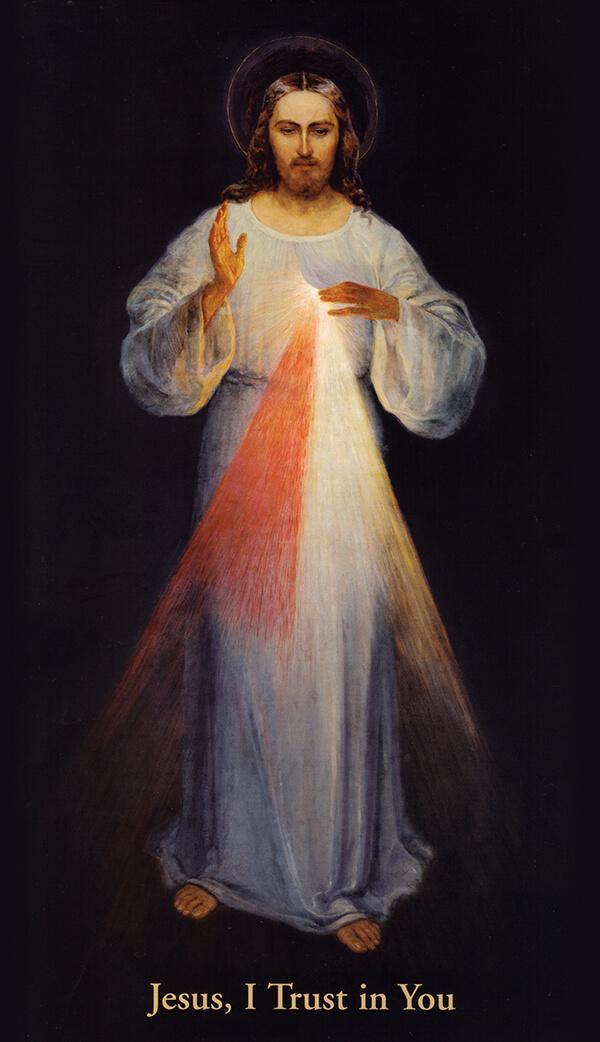
ABOUT THE DIVINE MERCY IMAGE
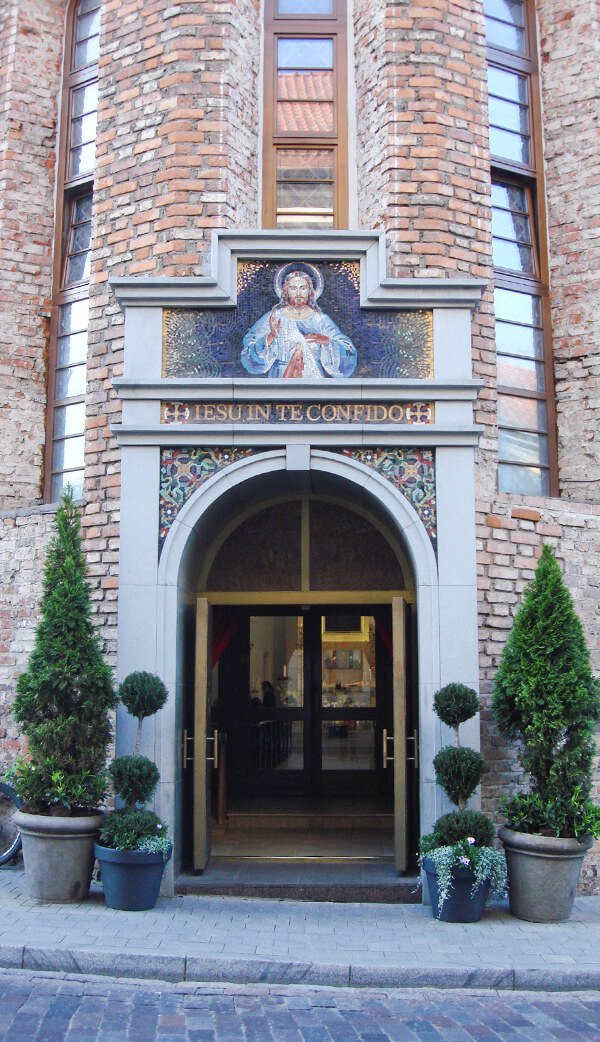
The image of the Merciful Jesus was painted as requested by our Saviour, according to the instructions given by St. Faustina in 1934, in Vilnius, Lithuania. This image is worshipped in the Shrine of Divine Mercy in Vilnius.
Lord Jesus said: “I promise that the soul that will venerate this image will not perish. I also promise victory over its enemies already here on earth, especially at the hour of death” (Diary, 47).
The image of the Merciful Jesus is often called the “Image of The Divine Mercy,” which is appropriate, since it is precisely in Christ’s Paschal Mystery that God’s love for humankind was most explicitly revealed.
The image not only represents The Divine Mercy, but also serves as a sign that is to recall the Christian obligation of trust in God and of active love toward neighbour. By Christ’s will, the image bears a signature comprised of these words: “Jesus, I trust in You.”
“This image,” Jesus also declared, “is to be a reminder of the demands of My mercy, because even the strongest faith is of no avail without works” (Diary, 742).
To the veneration of the image understood in this way, as relying upon the Christian attitude of trust and mercy, Our Lord attached special promises, namely, of eternal salvation, of great progress in the way of Christian perfection, of the grace of a happy death, and of all other possible graces which people will ask of Him with trust: “By means of this image I shall be granting many graces to souls; so let every soul have access to it” (Diary, 570).
DIVINE MERCY SUNDAY EXPLAINED
The Feast of The Divine Mercy ranks highest among all the elements of The Divine Mercy devotion revealed to St. Faustina. Its institution was requested by the Lord Jesus for the first time in Plock, Poland in 1931, while He was communicating His will regarding the painting of the Image: “I desire that there be a Feast of Mercy. I want this image, which you will paint with a brush, to be solemnly blessed on the first Sunday after Easter; that Sunday is to be the Feast of Mercy” (Diary, 49).
The choice of the first Sunday after Easter for the Feast of Mercy has a very deep theological significance, which points to the close relationship between the Paschal Mystery of the redemption and the mystery of The Divine Mercy.
The integral relationship is further emphasized by the Novena of Chaplets to The Divine Mercy which begins on Good Friday as a preparation for the Feast.
This feast is not only a day in particular for worshipping God in His mystery of mercy, but also a time of grace for all people.
The Lord Jesus said: “I desire that the Feast of Mercy be a refuge and shelter for all souls, and especially for poor sinners” (Diary, 699). “Souls perish in spite of My bitter Passion. I am giving them the last hope of salvation, that is, recourse to My Mercy. If they will not adore My mercy, they will perish for all eternity” (cf. Diary, 965, 998).
The greatness of this feast is measured by the measure of extraordinary promises that the Lord attached to this feast: Jesus said “Whoever approached the Fount of Life on this day will be granted complete remission of sins and punishment” (Diary, 300), and also, “On that day the very depths of My tender mercy are open. I pour out a whole ocean of graces upon those souls who approach the Fount of My Mercy.
To profit from those great gifts we must fulfill the conditions of the Divine Mercy devotion (trust in God’s goodness and active love toward neighbour), be in the state of sanctifying grace – having gone to Holy Confession, and worthily receive Holy Communion. Jesus explained: “No soul will be justified until it turns with confidence to My mercy, and this is why the first Sunday after Easter is to be the Feast of Mercy. On that day, priests are to tell everyone about My great and unfathomable mercy” (Diary, 570).
DIVINE MERCY SUNDAY EXPLAINED
For parish priests or leaders of parish ministries who may be interested in our prayer booklet of Divine Mercy Sunday during Exposition of the Blessed Sacrament, please download a free copy here.
THE CHAPLET TO THE DIVINE MERCY
The Lord Jesus dictated the Chaplet to the Divine Mercy to Saint Faustina in Vilnius on September 13-14, 1935, as a prayer for the appeasement of Divine wrath and of atonement for our sins and those of the whole world.
“Through the chaplet you will obtain everything, if what you ask for is compatible with My will” (Diary, 1731).
“Say unceasingly the chaplet that I have taught you. Whoever will recite it will receive great mercy at the hour of death. Priests will recommend it to sinners as their last hope of salvation. Even if there were a sinner most hardened, if he were to recite this chaplet only once, he would receive grace from My infinite mercy” (Diary, 687).
“When this chaplet is said by the bedside of a dying person, God’s anger is placated and unfathomable mercy envelops the soul” (Diary, 811).
To be said on the beads of a Rosary: “At first:
Our Father, who art in heaven, hallowed by Thy name. Thy kingdom come. Thy will be done on earth as it is in heaven. Give us this day our daily bread and forgive us our trespasses as we forgive those who trespass against us and lead us not into temptation but deliver us from evil. Amen.
Hail Mary, full of grace. The Lord is with thee. Blessed art thou among women and blessed is the fruit of thy womb, Jesus. Holy Mary, Mother of God, pray for us sinners, now and at the hour of our death. Amen.
I Believe in God, the Father Almighty, Creator of heaven and earth and in Jesus Christ, His only Son, our Lord, who was conceived by the Holy Spirit, born of the Virgin Mary, suffered under Pontius Pilate, was crucified, died and was buried. He descended into hell, on the third day He arose again from the dead. I believe in the Holy Spirit, the holy Catholic Church, the Communion of Saints, the forgiveness of sins, the resurrection of the body and life everlasting. Amen.
On the large beads (1 x): Eternal Father, I offer You the Body and Blood, Soul and Divinity of Your dearly beloved Son, our Lord Jesus Christ, in atonement for our sins and those of the whole world.
On the small beads (10 x): For the sake of His sorrowful Passion have mercy on us and on the whole world.
At the end (3 x): Holy God, Holy Mighty One, Holy Immortal One, have mercy on us and on the whole world” (Diary, 476).
PERSONAL TESTIMONY
The content below is derived from various talks and the blog (password Vilnius) written by the founder of All Things Possible Catholic Mission Society. Sharing this personal testimony is meant to inspire every living soul to learn more about God’s love and mercy and to know that when we surrender our misery, troubles and worries to Jesus, that graces abound.
This is confirmed in Notebook III of St. Faustina’s diary, where she wrote, “Today the Lord said to me, My daughter, My pleasure and delight, nothing will stop Me from granting you graces. Your misery does not hinder My mercy. My daughter, write that the greater the misery of a soul, the greater its right to My mercy; [urge] all souls to trust in the unfathomable abyss of My mercy, because I want to save them all. On the cross, the fountain of My mercy was opened wide by the lance for all souls – no one have I excluded! (Diary, 1182).
Reading St. Faustina’s diary changed my life. It also led me to another incredible book which my father encouraged me to read. The book is titled “The Way of Divine Love” and was written by Sister Josefa Menendez who was a Catholic nun. The book and her writings, were a pre-cursor to St. Faustina’s diary.
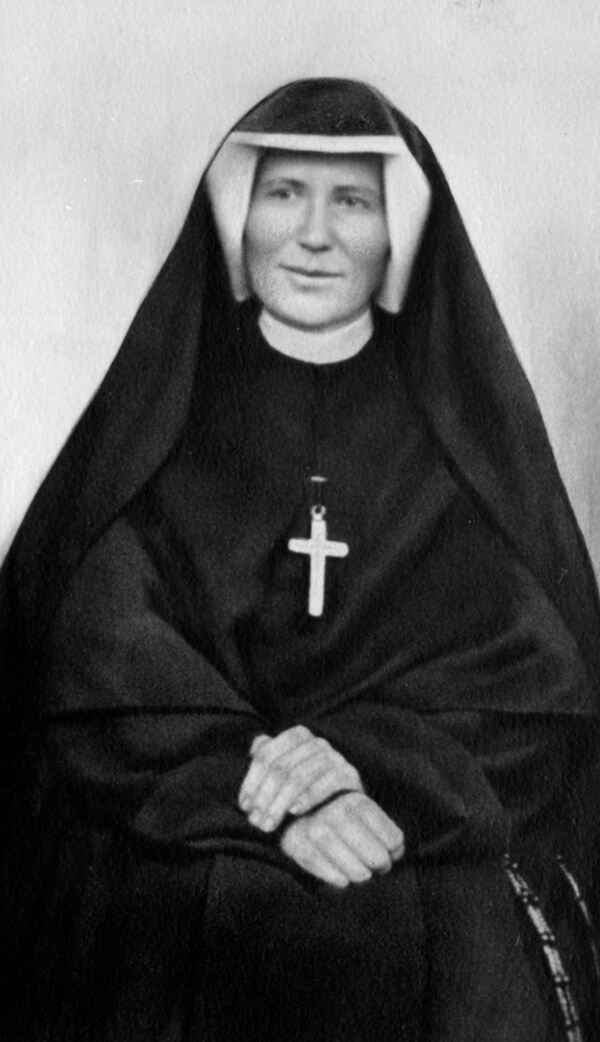
Sister Josefa Menendez was born in Madrid, Spain on February 4, 1890 and died in Poitiers, France on December 29, 1923. At this time, Helen Kowalska (Saint Faustina) was just 18 year of age and still two years away from being accepted by the Congregation of the Sisters of Our Lady of Mercy convent in Warsaw, Poland. Coincidentally both Sister Josefa and Saint Faustina both died at the age of 33. Both were mystics. Both suffered various trials to bring to the world the message of Divine Love.
If I were to recommend any two books to read, without hesitation, I would suggest The Diary of Saint Faustina and The Way of Divine Love by Sister Josefa Menendez. Both books profoundly changed my life and continue to shape me as a Christian and enlighten my knowledge of Catholic doctrine and teachings, but especially inform me that the Mysteries of Faith in the Catholic church are not simply tradition, but are to be embraced as mysteries for this is the full meaning of faith – to accept and believe without seeing.
My parting thoughts are for all of us to be an extension of Christ. We are each called to do what Jesus told Sister Josefa Menendez when he said “Do ordinary actions in intimate union with Me”. Notice he said ordinary. To be loving and merciful means living with an open heart and doing the most basic things for others without inventorying the cost. Deeds, words, then prayers should be where our focus lies and our abilities allow. Carrying this theme of love and mercy forward, let us be inspired by a beautiful quote from St. Faustina who said, “Love is Heaven given us already here on earth” (Diary, 278).
I pray that we all spring forward unconditionally to live the message of the Divine Mercy; for in so doing, we invite peace into our hearts, families, communities and into the world.
In keeping with the words of Pope St. John Paul II who on January 1, 1979 gave his World Day of Peace message and said:
“To everyone, Christians, believers, and men and women of goodwill, I say: Do not be afraid to take a chance on peace, to teach peace. The aspiration for peace will not be disappointed forever. Work for peace, inspired by charity which does not pass away, will produce its fruits. Peace will be the last word of history”
I say, PEACE BE WITH YOU!