Pink Door Construction Project,
Los Organos, PERU
1. HEADLINE:
Pink Door Construction Project, Los Organos, PERU
2. TIMELINE:
OCT 15, 2020, to JAN 19, 2023
3. THE CHALLENGE:
Rescue a family from potential homelessness. Move them from their current family dwelling into a newly built home in northern Peru. Overcome several obstacles, including the pandemic, to bring them shelter, safety, peace and a home for generations to come.
4. STORY
This is a story about friendship, love, hope, faith and family.
Many years ago, while first visiting northern Peru, Cathy, (one of our Society’s Directors), glanced into the possibility of building a recreational home on one of the beautiful and largely untouched beaches of Peru’s northern coastline.
For Cathy, the pull to northern Peru was so strong, that after her first visit in 2005, she purchased a beach front lot and shortly thereafter, built a home on the beach. Her passion for the area was the beginning of a journey that would result in her long-term investment, both personally and professionally, in northern Peru.
Over several years, Cathy bore witness to the area’s explosive growth. Major resorts and hotels were popping up all along the coastline of northern Peru. This produced a significant increase in regional capacity and infrastructure development. It also produced work opportunities for the local population and eventually resulted in the introduction of Cathy to Rosa who is the inspiration of this story.
Cathy discovered that Rosa was one of the locals. Rosa comes from a large family and was born and raised in northern Peru. She is also a wife, a mother of five and a grandmother of many. As the family matriarch, her primary goal is to ensure her family has a roof over their heads and food on their table. At the time that Cathy met her, Rosa was working wherever and whenever she could, taking on all kinds of jobs such as seamstress, housekeeper, laundry attendant, cook and even street sweeper in her local town.
When Rosa and her husband are unemployed simultaneously, the entire family bands together, and everyone contributes what they can to keep the family afloat, but even then, it is often a struggle to pay the bills.
Living on the edge of poverty, as I hope most people are aware, creates all sorts of very difficult challenges, not the least of which is trying to stay healthy in a country where health care for the poor is grossly inadequate. Tragically, marginalization of the poor is a global issue and northern Peru is by no means an exception.
On a more positive note, however, over the past several years, northern Peru has experienced significant growth in tourism. This growth has revitalized the local economy and created an increase of informal employment opportunities for the locals, including Rosa. With the increase in tourism, invitations and visitors to Cathy’s beach house increased as well.
In 2014, pursuing the idea of hiring someone to help her with housekeeping and other domestic duties, Rosa’s sister-in-law, who was by then providing services to others who had also built homes on the beach, introduced Cathy to Rosa. Cathy reached out to Rosa to see if she was interested in working for her. Rosa confirmed that she was available and interested and thus began a long and enduring friendship.
Cathy was thrilled to now have Rosa providing services for her at her beach home. It became obvious very quickly that Rosa was not only kind and hardworking, but also very intuitive and smart. Even with the language barrier she quickly understood Cathy’s needs as well as the needs of the other gringos and gringas who would come to vacation at the house. Cathy and she would laugh about how Rosa could understand Cathy’s broken Spanish or just intuit and act on what was needed. Rosa, also being sharp as a whip, began to understand English quite well, even though she did not speak the language. As the years progressed, so did the friendship between Rosa, Cathy and others who frequently traveled to Peru to vacation at the beach house, me included.
I now advance the timeline of this story to 2017 when a major flood event known as El Niño occurred in northern Peru between the months of February and March. It is important to relay the details because it was the first of many events that would lead Cathy and me to find a solution for Rosa and her family to a future predicament that will become obvious as I continue through this story.
For a point of reference, to illustrate how bad the flooding was, I have inserted some photos below. The first photo captures the state of disaster caused by the flash floods at the beach.
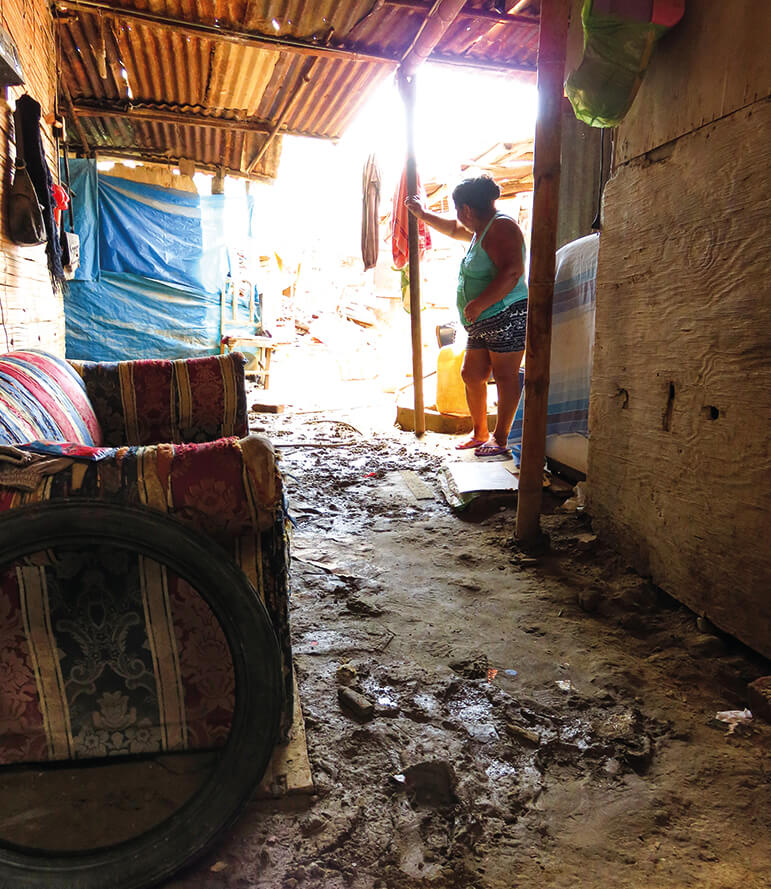
The second photo shows the severity of damage that caused Rosa’s house to become uninhabitable in parts.
And the third photo shows the devastation of the Pan American Highway, the only transportation hub that connects the north to other areas of Peru. Without it, goods and essential services would be cut off entirely.
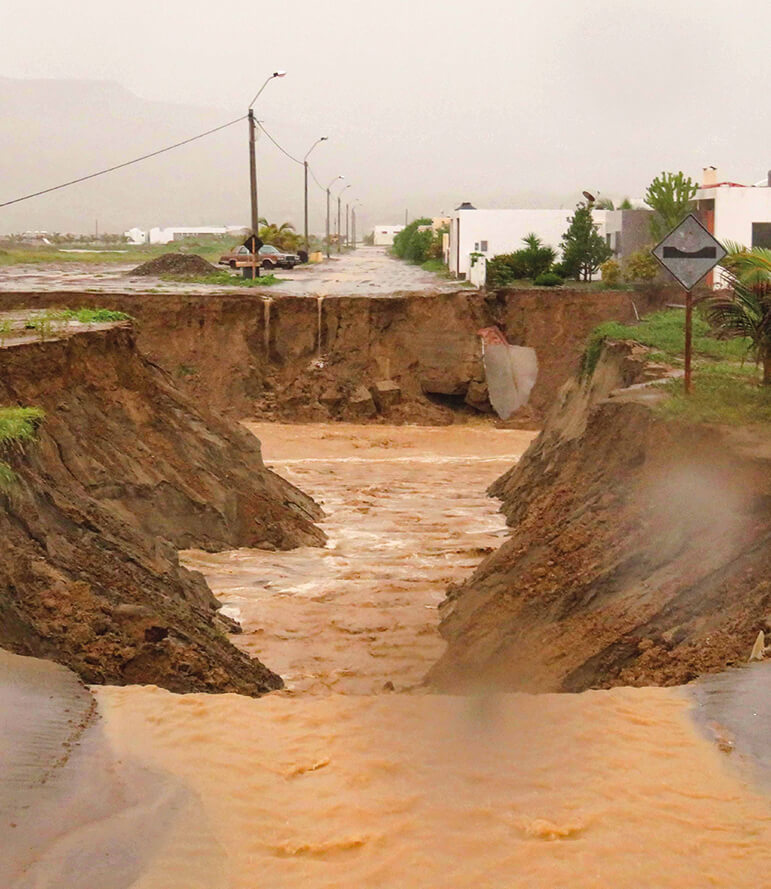
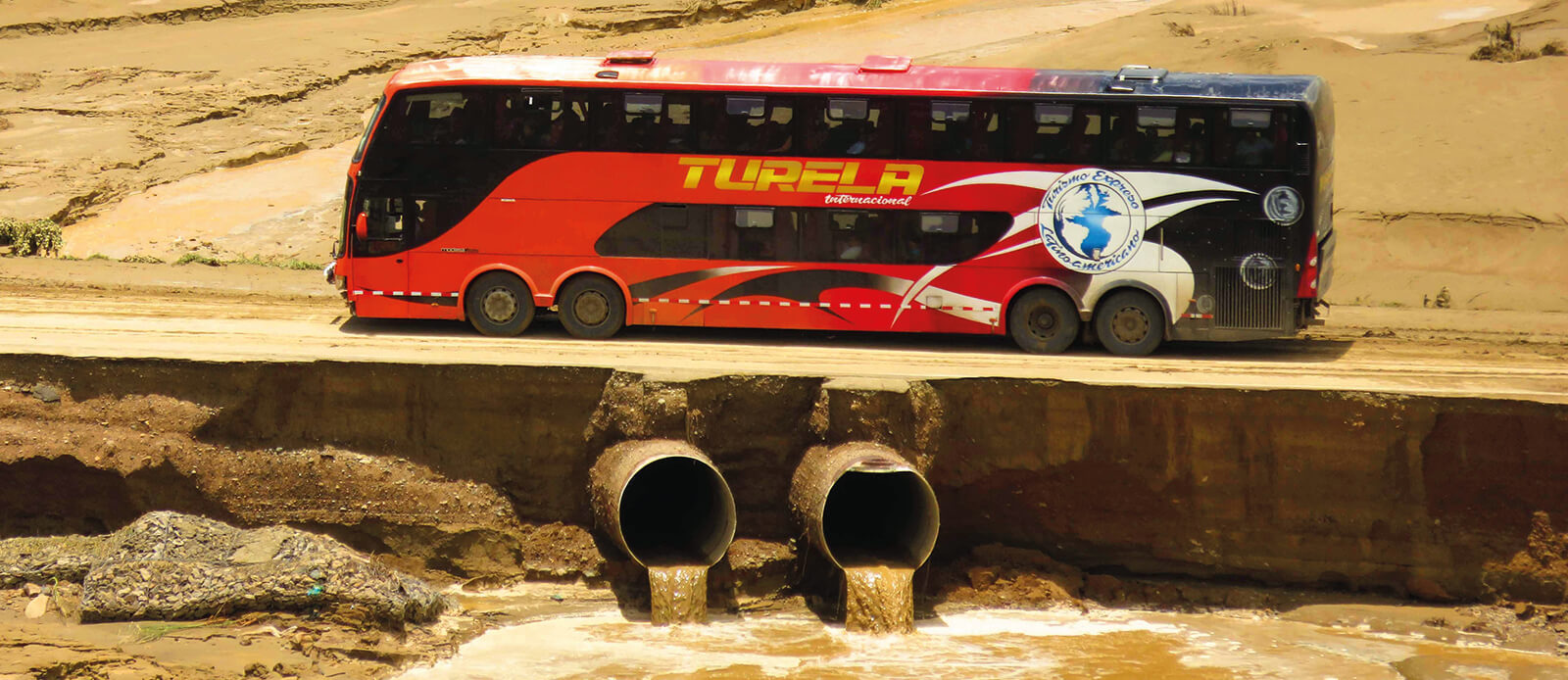
The heavy and sudden torrential rains pummeled the north during the 2017 El Niño and not only brought devastation to 40,000 homes and families, but to highways and civil infrastructure as well.
Next came insects, disease, and sickness. It took nearly three years for some parts of northern Peru to recover from the catastrophe.
By late 2019 things had mostly returned to normal as far as what was visible, but there was little improvement to Peru’s economy. Despite political unrest and flood damage to a massive part of the country, Cathy returned to northern Peru in December of that same year.
Making sure to prepare the household in advance of Cathy’s return, Rosa would commute by moto taxi from her home in Los Organos to the beach house. Getting around in Los Organos in such a manner is relatively safe, however, getting to the beachside property meant enduring an 8 km journey on the perilous Pan-American Highway which Rosa gladly did on many days when Cathy was unable to pick her up and take her home.
Shortly after Cathy’s return to Vancouver in January 2020, Covid-19 snuck up on the world. The human family was caught off guard and for months the world was in a state of lock-down.
According to the World Bank, Peru was one of the countries hardest hit by Covid-19, with the number of deaths per 100,000 population being among the highest in the world. The decline in global demand and the implementation of lock-down measures had large impacts on household income in Peru. Total employment fell by 39.6 percent (about 6.7 million workers) in the second quarter of 2020. Earnings and hours of work also declined for those who remained employed. According to the High Frequency Surveys conducted by the World Bank, Peruvian households experienced the largest employment and income losses among 13 countries in Latin America and the Caribbean since informal jobs were both more vulnerable and more prevalent in Peru.
As previously mentioned, prior to Covid-19, Rosa’s family was accustomed to the inconsistency of employment; and whenever there was a short fall, the family would band together to bridge the gap. After Covid-19 hit, however, when it felt like the world had unraveled and fallen backwards, Rosa’s family really suffered. Health services and government support for the poor, already abysmal, became almost non-existent and massive portions of the population, including Rosa’s family, grew even more impoverished. The sporadic informal employment they relied on dried up entirely during the pandemic. As a result, and not surprisingly, they, as well as many others living in poverty, were the hardest hit by the pandemic.
To make matters worse, in August of 2020, Rosa’s mother-in-law, Esther, died of Covid in her own home – the same home in which Rosa and her husband and several other family members lived. Rosa, her husband, and family were devastated by Esther’s death but adding insult to injury, because Esther had several children, rightful ownership of the home Rosa and her family lived in came into question.
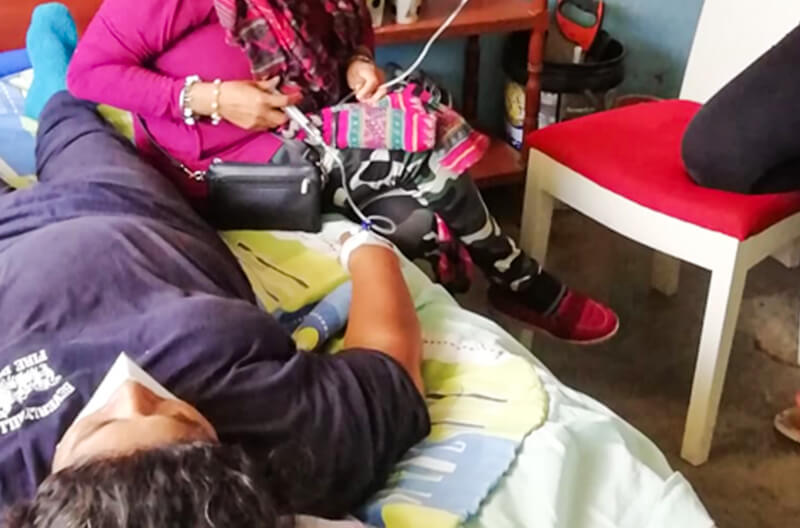
Soon after Esther’s death, and before the Covid-19 vaccine was available in northern Peru, Rosa was also infected with the first strain of the virus.
Rosa got very sick and for a few days, it was touch and go. She needed bedside care as shown in the photo to the left. Her family rallied around her.
Prayer vigils were said in Canada for her Rosa’s full recuperation.
Thanks be to God she made a full recovery!
Around October 2020, the house Rosa lived in became a topic of debate among her husband’s siblings. Despite the in-home care that Rosa and her husband gave to Esther for years, her other children decided they wanted to take possession of the property. I remind everyone reading this to look back at the photo of the house after the flooding. This in and of itself was a meager dwelling but to Rosa and her family it was home and, for that matter, all they had. The subject of occupancy and ownership of Esther’s house took precedence in the minds of her relatives over the welfare of Rosa and her family. This fractured Rosa’s heart.
Given these circumstances, and the chain of events described earlier, Cathy and I agreed without hesitation that we would help our dearly loved Peruvian family. I say Peruvian family because Rosa is our family, and we love her and her family as our own.
Around the third week of October 2020, we discussed solutions that might help resolve Rosa’s impending eviction. Cathy and I then arranged a conference call with Rosa and a professional Spanish interpreter named Liz. We needed Liz on the call with Rosa because our Spanish was not at the level required to discuss such serious matters. During the call, Liz skillfully ensured everyone had an opportunity to speak and to be heard. With her help and expertise, we were able to establish what needed to happen to make sure Rosa and her family were not stranded and potentially left homeless.
Rosa was very sad on the call but after translating the current situation regarding the house, Liz was able to restore emotional balance. By the end of the call, Cathy and I let Rosa know that we would reconvene in a week’s time to discuss solutions to help her and her family out of the dire circumstances they found themselves in. This brought a tone of optimism to Rosa’s voice. Cathy, Rosa, and I also decided that weekly calls were needed to ensure things progressed.
On the second call a week later, led again by Liz, Cathy and I proposed the idea of Rosa’s husband buying his mother’s house with the help of a loan from us. This would ensure Rosa and her family could stay in the home permanently. It seemed like a win-win solution, however, when the idea was pitched by Rosa’s husband Albert to his siblings, they voted against it and reinforced the need for him and Rosa to move out as soon as possible.
As they had nowhere else to go and certainly no money to spare, the next conference call focused on a temporary solution for Rosa. Cathy offered Rosa and her family the option to stay at her beach house until a longer-term solution was found. But for several reasons, namely access to local food supply and amenities, the idea was rejected. Very tight Covid-19 restrictions were in place on the beach, which meant that Rosa and her family once there, would not be able to leave the property. This was not a realistic solution, so the idea was scrapped and Cathy and I went back to the drawing board.
On our next weekly call, to our delight, we learned from Rosa that in the past, some of her family members had squatted on two lots of unused municipal land on the outskirts of Los Organos. These lots were not far from the house they lived in but because they were off the grid, the family was able to apply for property title. Squatters’ rights are very strong in Peru, which sounds very positive for those occupying the land, but it is important to also understand, that there is a litany of problems that come with taking possession of land located off the municipal service grid such as access to water, sewer, and electricity.
Regardless of the potential challenges, finding out about the two small lots allowed us to entertain the possibility of building a house for Rosa and her family. We learned that electricity was available in the area but that water and sewer services were not and would not be until agreements were in place between SEDAPAL (Peru’s main provided of water and sewer services) and the Municipality of Los Organos. The work around in the interim, was to pay for potable water to be trucked in.
Despite the obvious challenges, and because they had the land and we had the means, we agreed to build Rosa and her family a new home. And so began the process of planning and construction.
With the help of a local contractor, the house design and contract details were finalized. The contractor broke ground on November 16, 2020, which is when the levelling and topsoil removal began as shown in the photo to the right.
The goal we hoped to achieve was to finish construction in time for Christmas occupancy.
As pre-construction activities progressed, we soon recognized that this timeline was too ambitious. That said, incremental progress was made despite the limited supply of workers, delays in the procurement of materials and further Covid restrictions.
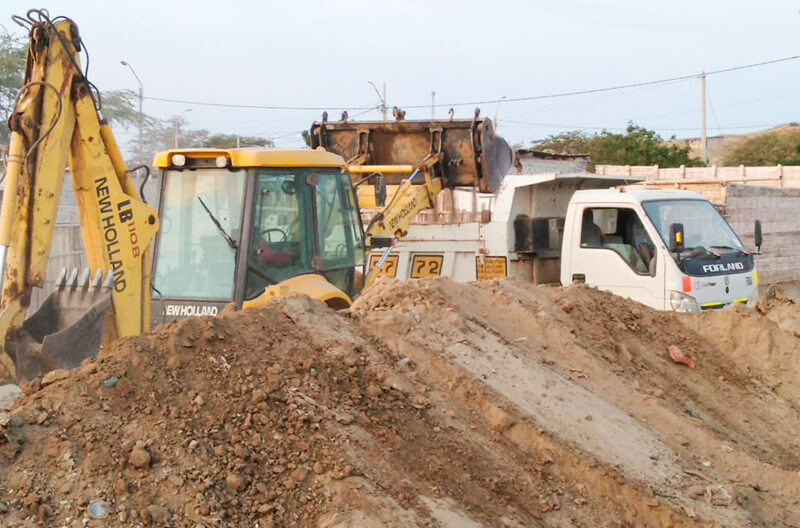
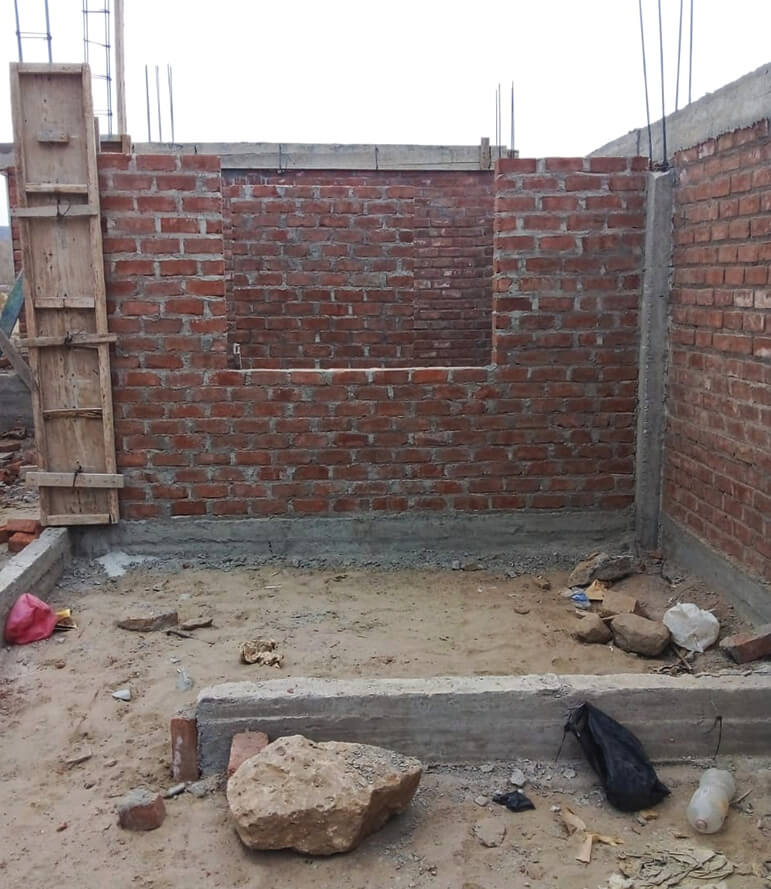
After the removal of topsoil and levelling of the land was complete, holes were dug for sewage and footings (concrete slabs to support the foundation walls) as shown in the photos below.
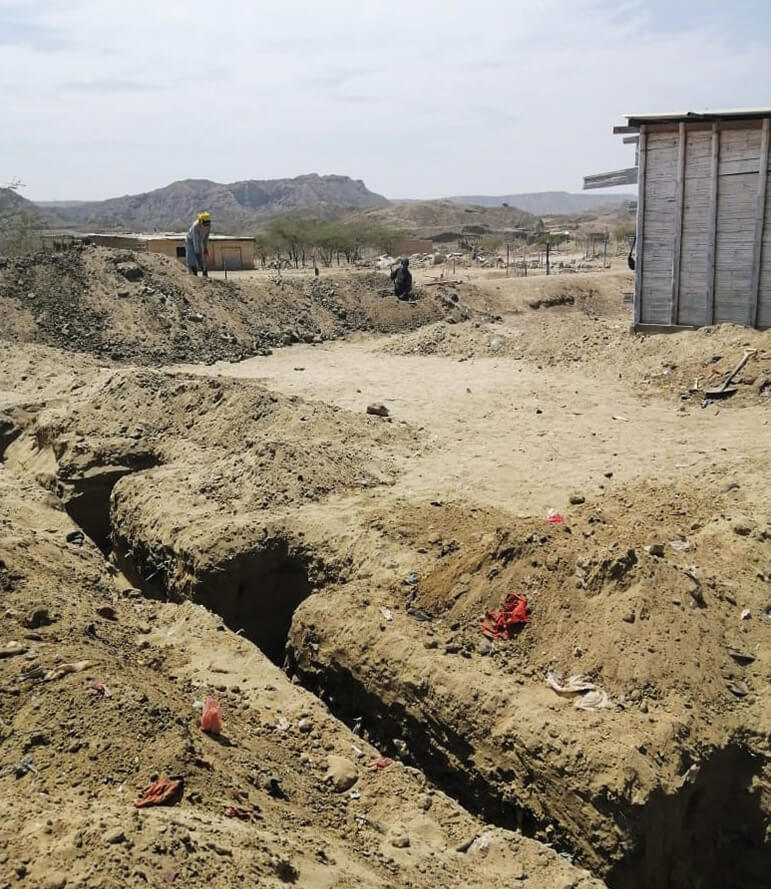
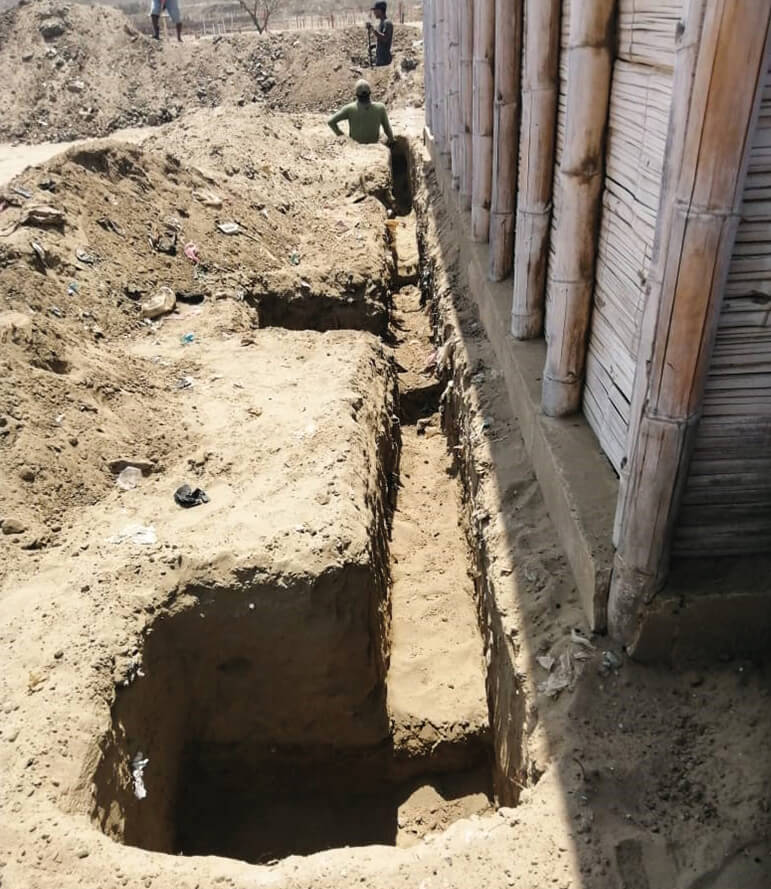
By mid-December 2020, the foundation, footings (concrete reinforced by rebar) and exterior brick walls were mostly complete. Around this same time, more of our prayers were answered. Rosa and her family were given permission by her in-laws to remain in their current home until the new house was ready to move into.
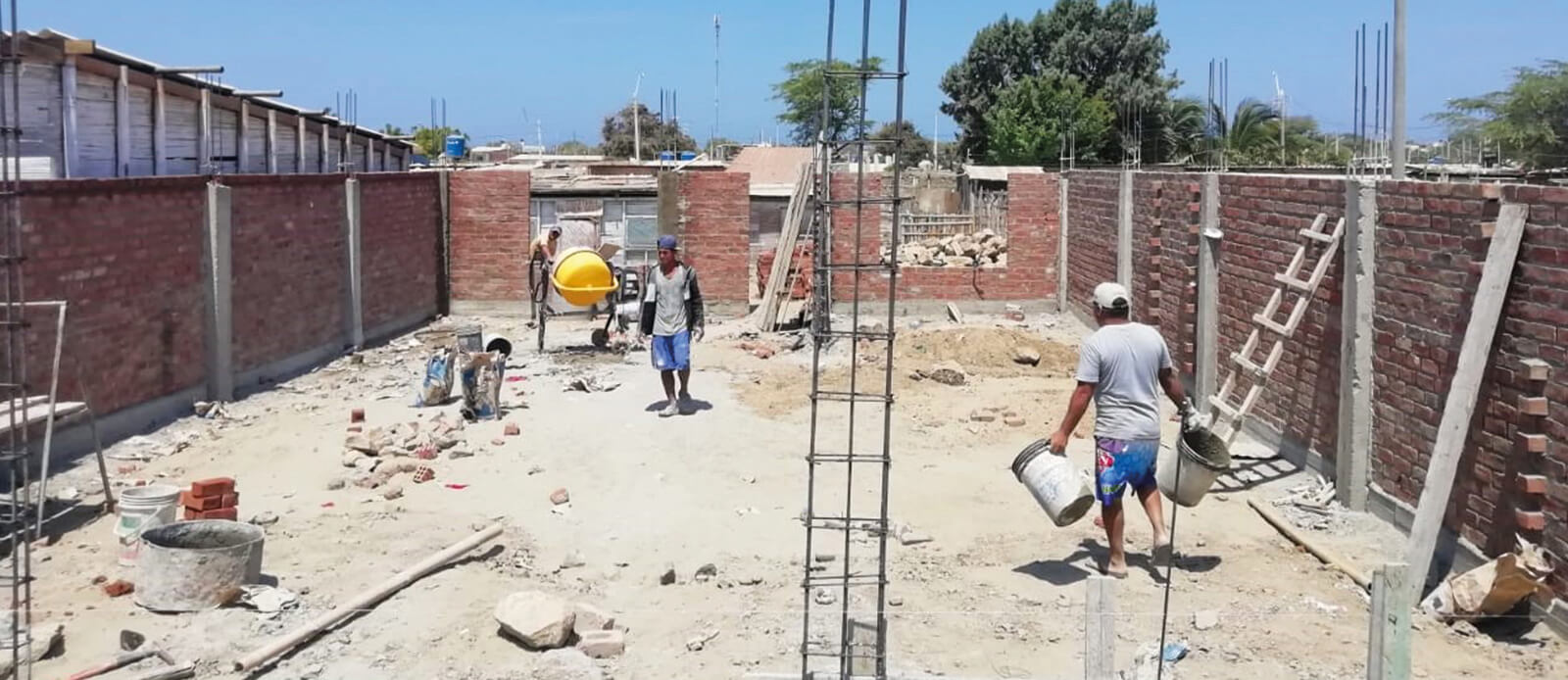
Due to supply chain issues and challenges, namely delays in the delivery of materials to the building site, work for the remainder of December 2020 tapered off. A skeleton crew remained in place and began constructing the inner walls of the house. Progress was slow, but steady.

By mid-January 2021, a flurry of worker activity ensued. The emphasis was on roof construction.



As with any construction project, change orders are to be expected. This project was no different.
In January 2021, two <2> time and materials change orders were presented to the project sponsors for consideration.
The first change order was for a product called SIKA (a sealant) to be applied to the newly finished concrete roof – a small investment required to protect the concrete surface from water ingress and other weather elements such as sun scorch and wind erosion.
The second change order was for specialty trades to mix and apply layers of plaster to the unfinished ceiling areas on the inside of the house. This would render a flat finished ceiling that could easily be painted in the future. The photo shown below is what it looked like before the ceiling was professionally stucco plastered.

By February 2021, work was paused due to strict Covid-19 restrictions imposed by the local health authority, all the while, electrical and plumbing materials were procured and installed inside by electricians and plumbers.
By April 2021, the last construction milestones were fast approaching. Most of the walls had been plastered; the concrete floors had been poured (see photo below); and most windows and doors had already been installed.

In May 2021, Covid-19 cases surged to an all-time high in Los Organos. Strict curfews were put in place. Many people were sick and dying from the virus. Still, no vaccine was available to the public. There were so many cases of Covid that even the Red Cross was forced to cancel their scheduled vaccine appointments in Los Organos for those who were most vulnerable. For these reasons, plans were put on hold for Rosa and her family to move into their semi-finished home. But, while the work stoppage was in progress due to Covid restrictions, despite the non-existent supply of municipal water at the new house, a family member who got Covid was able to self-isolate there and provide security watch on the premises.
Finally, in November 2021, nearly one year after breaking ground, Rosa and her family moved into their new home. Most of the contracted work was complete and it was agreed that future improvements would be made by Rosa and her family.
The timing of the official move into the new house could not have been better because in December 2021, Rosa needed her family more than ever. Her mother died suddenly of a heart attack. This was totally unexpected as her mother was in stable and good health. Rosa was inconsolable and when we spoke with her on the phone, it broke our hearts to hear the profound grief in her voice. Yet, because of the love from her family and friends, hope prevailed.
A few weeks after ringing in the New Year of 2023, several members of Rosa’s household were supplied with paint and began painting the exterior of the house. The finished product can be seen below along with Rosa, her husband and several members of her family.


In parting, I share an email written by Rosa’s granddaughter to Cathy on December 27, 2021. It is meant to ignite hope for those who are in despair; to remind us that love can conquer all; to incite us to be courageous when others need us most; to perform deeds for others without counting the cost; to recognize that we are all the same; to strive for constancy of compassion in our hearts; and to know that family exists even in places we are not always familiar.
“Hello Aunt Cathy. I hope you are well. I write to wish you a Merry Christmas and a beautiful New Year. I hope you had a nice time and were with the people who love you just like us. Over here we are fine. My grandmother Rosa has been a little bad, but she is already recovering. I hope you come soon and that I can meet more friends of yours. We had a great time at Christmas with the whole family. Thanks to you for this beautiful house that you gave us. We pray that the Virgin Mary takes care of you and always protects you in your life. You are our angel who saved us. We have been a bit sad because of the loss of my grandmother’s mother, but we are fine, Aunt Cathy. Well, I say goodbye, take care of yourself, we love you very much. 🥰🥰🥰 See you later.”
5. OUTCOMES:
Life, hope and faith renewed for a family helped through extreme adversity. Bonds of friendship and family strengthened. A new home constructed in which to bequeath to future generations.
6. QUOTE
On January 16, 2023 at Cathy’s beach house, at the same time Cathy and Rosa were embracing and Rosa said “I am so grateful. Thanks be to God and to you and Deborah”, a feather flew into the house and fell onto the floor. A reminder of the gifts we receive when we give.
7. PSALM-PRAYER:
Rise up, Lord, in defense of your people; do not hide your face from our troubles. Father of orphans, wealth of the poor, we rejoice in making you known; may we find comfort and security in times of pain and anxiety.